Skip to content

Philosophy

2023: A great year for me, but a bad year for the world

Living is easy with eyes closed. - John Lennon

As this year comes to a close, it's so easy for me to put a bow on this year. It's been a great year for me personally; I've learned a lot, got a new job, and spent a lot of time with people who are important to me. But what about everyone else? Has it been a great year for them as well?

I doubt it has. There have been a lot of unfortunate events this year: war, impending doom due to climate change, mental health crises, and a bunch more that I'm undoubtedly forgetting.

It would be easy to ignore everything and act like my experience is the only experience. However, I don't think that's fair. It's not fair to those who have lost their lives due to their religious beliefs. It's not fair to people who have decided to take their own lives due to overwhelming stress and anxiety. It's also not fair to communities who have lost everything due to extreme weather events.

So how do us empaths go about our lives without feeling guilty and solemn all the time? I'm not sure I have the only answer, but here are a couple of things that I do that seem to help me balance the luxuries of my own life with attempting to alleviate suffering for others:

1. Be grateful for everything you have.

This is the easiest thing to do on this list, and it's free. If you and I went to a restaurant and ordered the exact same thing, and if I was grateful for the meal and you weren't, you can bet your bottom dollar that the meal would taste better for me than it would for you. Sitting down and trying to think of one or two reasons why I'm grateful for anything and everything at least once a week is a practice I've implemented this year, and although I'm not that great at it yet, I can tell that it's made me more appreciative of everything and everyone around me.

2. Donate or give away things you don't use, want, or need.

That Xbox One that's been sitting in your closet for the past 2 years after graduating from college could go from never used to never turned off. The old clothes that you hide in the corner of your closet could go from collecting dust to keeping people warm this winter. The little things add up. This practice also helps you declutter your life and focus on the things that matter.

3. Make small recurring gifts to a charitable cause that is important to you.

In my own life, I'm averse to donating large amounts of money at one time, but I am totally okay with spending $5 at Starbucks twice a week. One thing that's helped me become less of a glutton with my money is to make small recurring gifts to charitable causes in my community. Even though it probably adds up to more or less the same amount if I donated a lump sum once a year rather than small, frequent amounts, it's just easier for my brain to meet halfway with my heart when rationalizing it this way. Also, if you're a selfish altruist like me, sometimes you get cool gifts like socks or a t-shirt if you become a recurring donor rather than a one-time donor, which just helps with incentivizing our monkey brains into continuing to donate... but, if it works, it works.

4. Lastly, take a break from news every once in a while.

This one is pretty important too. It's sad to say that almost all of the news we consume is sad news, and it definitely takes a toll on us. Try to go a few days or a week every month without consuming any news, or replace all of your sad news consumption with cute animal videos or by picking up a new hobby. This also applies to social media. We all know that avoiding social media is almost always a good thing.

Even though there are so many sad things happening in the world, know that there are always good people out there, and there will always be people who care about you because I care about you!

Happy Holidays!

I leave you with these words of passage John 14:27:

Peace I leave with you; my peace I give you. I do not give to you as the world gives. Do not let your hearts be troubled, and do not be afraid.
Saying goodbye is hard

This is a 4 minute read.

How lucky I am to have something that makes saying goodbye so hard. - Winnie the Pooh

Throughout my life, I’ve had plenty to be thankful for. My mom left everything behind in Honduras in search of a better life in the United States and brought me with her. I’m thankful for that. I've also graduated from college with a bachelor’s degree, an achievement attained by only 7% of the world’s population.1 I’m thankful for that. Being able to wake up every day without worrying about my next meal or where I'll sleep tonight is something that I take for granted way too often, but I'm very thankful for that.

Recently, I’ve been reflecting on how grateful I am to have a job. Some people might not enjoy their job; some might even hate it. However, I consider myself fortunate to enjoy and feel passionate about what I do. I love spending hours trying to solve complex issues and the rewarding experience of being in a state of intense focus, which some might call "flow." In those moments, all that matters is the challenging problem I'm trying to solve, and the sense of timelessness while in flow state is extremely fulfilling.

It's also very rewarding when you are surrounded by great people. My colleagues have played a pivotal role in my professional and personal growth. I’ve had the opportunity to collaborate with talented architects, analysts, and engineers, and I've learned so much from these remarkable individuals. I’m very thankful for that. I’m also grateful for the opportunities I’ve had, being able to explore areas that interest me and having the opportunity to work with cutting-edge technology.

For all the reasons mentioned above, saying goodbye is so difficult. Goodbyes happen to be something I struggle with the most. It's challenging for me because I'm not particularly fond of change, especially when 40 hours of any given week are spent at work. It's way easier to stay where you are comfortable, especially if you are somewhat good at it.

Although it won’t be easy, embracing change is essential for personal and professional growth. It requires you to take risks, such as trying something new, in the hopes of it teaching you something you don't already know.

Goodbye, CapTech, and thank you for everything.


  1. “100 People: A World Portrait” 100people.Org, www.100people.org/statistics-details/. 

Doing More with Less (like dogs)

This is a 3 minute read.

We all wish for more of something - more money, more friends, more time. Some of us might even crave more of everything. Sadly, the truth is that having more often makes us want even more. The initial excitement of something new fades away after a while, whether it's days, weeks, or months. Then, in a vicious cycle, we're onto the next new thing.

I see this happening all the time in my life and in the lives of others. We're well aware of this reality. Apple does a great job of convincing me to trade in my perfectly fine iPhone for the latest model each fall. Their ads make us really want it. We tell ourselves, 'The new camera is so useful, and it surely justifies the thousands of dollars I'm about to spend on the new iPhone Pro Max XR Ultra.'

How much happier would I be the day after getting the new phone? I'd probably feel pretty excited about my new phone with its new camera, screen, and all that good stuff.

How much happier would I be a month after getting the new phone? Probably not much happier than I was on the first day I'd reckon.

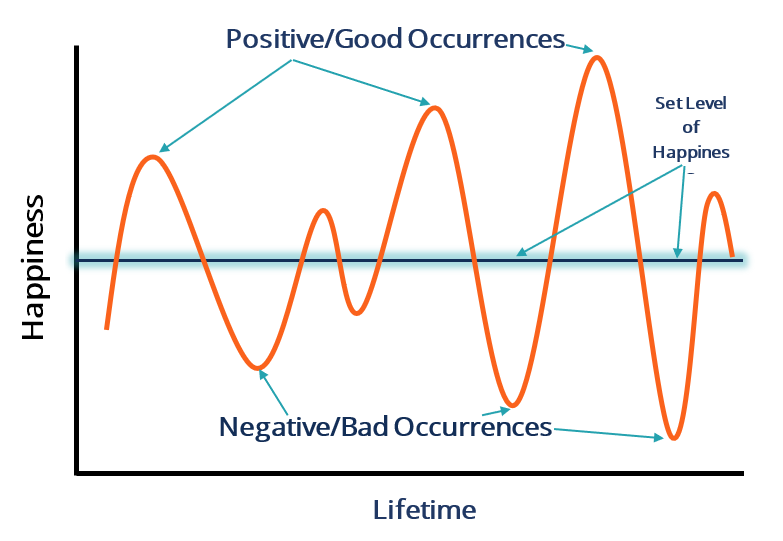
This phenomenon is called the hedonic treadmill1 or hedonic adaptation. It means humans tend to return to a stable level of happiness after extraordinarily good and bad events. Over our lives, we experience fantastic highs and tough lows, but we usually come back to a basic level of contentment. This can be shown on a graph like this:

Hedonic treadmill

So, how do we react to this information? Some of us might think, 'Humans are quite tough. We can bounce back from dark moments pretty quickly with time.' Others might wonder, 'What's the point of enjoying happy times if we'll just end up less happy again?'

Both reactions make sense. My response to that is to enjoy the positive moments to the fullest, knowing you'll probably return to a less happy state shortly after that really good event. On the other hand, knowing that difficult times will fade can make suffering a bit easier to bear, being sure that the light at the end of the tunnel isn't so far away.

We can use a similar approach in our jobs, especially in tech. Imagine two options: reworking the entire architecture from scratch, or examining current resources for inefficiencies and room for improvement. Taking inventory of the current architecture first might reveal new insights and quick fixes to tough problems.

Completely redoing the architecture usually takes longer, needs staff training in new technologies, and might lead to downtime. It's also quite expensive. On the other hand, finding areas to improve in the existing setup is usually quicker, cheaper, and easier. We can apply this to our personal lives too. Instead of seeking external solutions like alcohol, drugs, or shopping, we can reflect on what's draining us internally and take the first step to improve.

(like dogs)

With all that said, dogs are really good at this hedonic treadmill thing. Dogs have to be some of the happiest creatures on Earth. Take my dog, Luna, as an example. Luna has only a couple of possessions: her collar and her favorite toy (named Gussy). She doesn't need a new iPhone, she eats the same food, and does more or less the same things every day. Luna seems to maximize the happy moments, and quickly bounces back from a rut. Luna also doesn't need new things in her life constantly to feel happiness.

Let's try to be more like dogs in our daily lives.


  1. Brickman; Campbell (1971). Hedonic relativism and planning the good society